
Water, Sanitation and Hygiene (WASH) Status in Kenya’s Health Facilities
Introduction
Kenya is faced with inadequate investments for Water, Sanitation and Hygiene (WASH) in health care facilities. Devolution of health services to county government levels has necessitated domestication of national policy guidelines and standards at county and local health care facilities. These are expected to have a major impact on WASH in health care facilities. However, there were major challenges that ranged from awareness of WASH, policies and infrastructural developments.
WASH Awareness
Relatively, most health workers including community health workers had some knowledge of WASH. However, they did not understand national/county policy guidelines and standards for WASH at the health facility. For the community, most of them understood WASH to be merely about water alone. Community members were rarely informed about WASH in health care facilities (HCFs) when they visit the health facilities for services.
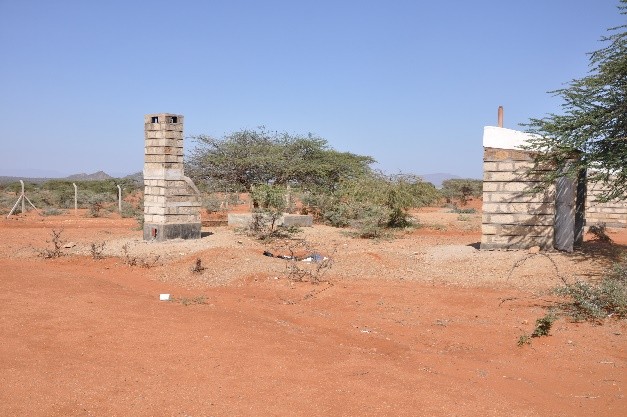
Waste disposal and incineration area at Kipsing Health Centre, Isiolo County.
Status of WASH Infrastructures
Kipsing Health Center
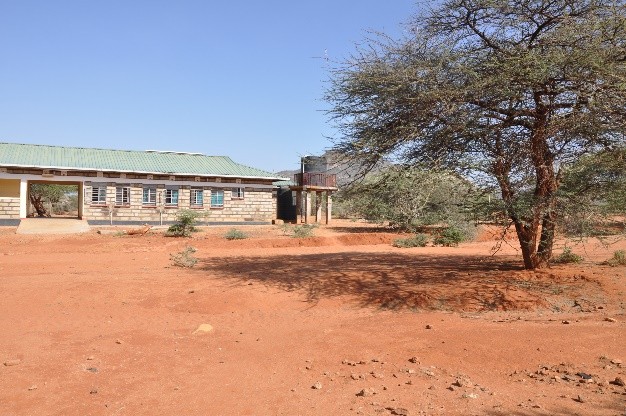
Kipsing health center has relatively well-established WASH infrastructural development. To begin with, there are four 10,000 liters water tanks for collecting rain water and a borehole which supplies water to the health facility. Kipsing has a dumping site for organic wastes and well-constructed incinerator for chemical or pharmaceutical wastes disposal. The dumpsite and the incinerator are barely 50 meters from the nearest building within the facility. The incinerator has an inlet and outlet to facilitate servicing.
Moreover, the health facility has newly constructed two-door latrines and an extra one without a door. The latrine floors were raised, smooth and impervious for ease of cleaning. The latrine had relatively good privacy with a roof to prevent rain from damaging the floor and small opening on the walls for aeration. The facility is averagely clean having employed staffs to undertake the cleaning within the facility. However, there was no WASH facilities for persons with disabilities. For example, all the latrine doors were small in size of which a wheelchair could not go through, no hand rails for support, or a ramp.
At the Kipsing health center, despite having sufficient pieces of equipment for collecting water, there was no reliable water within the facility. Community complained of lack of water including for taking medication at the facility. Also, hand hygiene mechanism was a challenge as there was neither soap, detergent nor reliable water to use after visiting the toilet or for health workers to use after attending to a patient. Latrines were only cleaned once a week.
It was noted during the forum that in addition to lack of hand washing mechanism, community members use stones or sticks for lack of tissue paper.
At the maternity, there was no water point within the wards of which patients have to rely on someone to fetch water outside the maternity. Sanitation within the maternity, was relatively low because it was only cleaned when the need arises. The maternity wing is located a few meters away from the latrines of which there was foul smell from the latrines. Moreover, the dumpsite is not deep enough to safely keep the litters intact because there were cases where the wind would blow away litters from the dumpsite.
Gumba Dispensary- Nyeri County
Gumba Dispensary is a government health facility located in Githi Ward, Mukurweini Constituency in Nyeri County. The facility offers Antenatal services, Basic Emergency Obstetric Care, Curative Outpatient services, Family Planning, Growth Monitoring and Promotion and Immunization. On WASH infrastructure development, Gumba dispensary has relatively good latrine divided into six door unit constructed distance apart for male and female however, no visible labelling put on the doors.
The facility had a 10,000 and 2,000 liters water tanks for water storage. Small buckets were improvised for hand washing placed next to the latrine. The maternity unit had its own water tank and it is regularly cleaned. Additionally, it emerged from the discussion that the facility highly depended on rain water for use and whenever there was a long drought. Though the facility is connected to Nyeri Water and Sewage Company, availability of the commodity was a challenge.
The latrines had well raised, smooth and impervious floor that was easy to clean. Privacy while using the latrines was relatively good as the doors were well lockable, good aeration, and a protective roof to prevent individuals from sun or rain. However, Gumba dispensary had no incinerator and a proper dumping site, hence, they had to improvise other methods of disposing chemical and pharmaceutical wastes. In terms of hygiene, Gumba dispensary is relatively clean. There was a WASH staff who kept the toilets, corridors and the walkways clean.
Samburu Complex dispensary- Isiolo County
Samburu complex dispensary is relatively small health facility. The facility is within the Kenya Wildlife Services base camp and has access to piped spring water, for the community within this camp adequate supply of water is guaranteed. However, the piped water is not available at the latrines. The facility lacks handwashing practice because only available water tank near the ablution block was broken down. There were no dustbins around the facility for garbage collection. Nonetheless, there was a dumpsite few meters away from the facility and a poorly constructed incinerator. The incinerator had an inlet but had no outlet or a means of burning the wastes disposed therefore the incinerator was full of waste without proper channel of emptying it.
Additionally, the Samburu complex had two door latrines which were clean according to the local standards but had no water for hand washing, detergents, tissues papers or safety bucket for sanitary towels. The toilets were not friendly to people with disability. For example, all the latrine doors were small in size of which a wheelchair could not go in, no hand rails for support, or a rump.
The maintenance of WASH services was relatively low. Latrines were not regularly cleaned as expected. Considering the area is semi-arid, it is quite dusty which requires well scheduled cleaning plan but there was no schedule of cleaning within the facility. Moreover, some of the latrines within the facilities were left for ruin without proper maintenance.
In nutshell, it was clear that some of the facilities had attempted to comply with the policy for WASH in HCF on Quality Standard for Kenya Essential Package of Health 2009. However, some of the notified challenges were on the training of personnel responsible for waste disposal, keeping of waste handling record, provision of personal protective equipment personal protective equipment (PPE) If most of the health facility comply with this policy.
WASH Budgeting
One key challenge to WASH that was identified across various facilities was the financing for WASH. In Isiolo, Kipsing Health center, it was noted that the county allocates KES 100,000 to Health Facility Management Committee (HFMC) to employ several supporting staff among them the WASH staff. However, there was no vivid clarification on the amount budgeted for WASH in health facilities in Isiolo County.
In Nyeri County, the department of Finance and Economic Planning submitted that WASH budget was under multiple departments which may present a tracking challenge. They clearly stated that part of the WASH budgetary allocation is under the Health and the other in Water, Sewerage and Sanitation, Environment and Natural Resources departments, including special programs.
Additionally, they further clarified that the allocation for WASH under each department was entirely dependent on the department heads’ preferences because there is no policy that governs WASH budgetary allocations within the department.
During the community forum in Gumba dispensary in Nyeri County, County Health Management Team (CHMT) representatives stated that WASH budget cannot be tracked under one budget line and even the CHMT could not tell how much was allocated for WASH in HCFs.
However, County department of water, and sanitation was expected to complement health facilities with water during water shortages.
Conclusion
Despite devolving health facilities to county government, level of WASH awareness within HCF is still very low in Kenya. National policy, guidelines, and standards are still not understood by the health workers within the health facilities and community members seeking services despite their existence. Policies that support WASH in Kenya ranges from the constitution of Kenya, Vision 2030, National Health Policy Framework 2012-2030, Quality Standard for Kenya Essential Package of Health 2009 to sustainable development goals. Lack of health education on WASH in health facilities is one of the factors that has reduced the level of awareness in health facilities. Additionally, there are no Information, Education and Communication (IEC) materials within various health facilities to sensitize the community on WASH.
Furthermore, lack of budgetary allocation for WASH, as brought about the challenge of accountability of WASH finances. Therefore, there were poor WASH infrastructure which lack stable procedure of maintenance and service delivery. If water, remained a challenge in health facilities then it would be impossible to achieve good quality of healthcare services.
It is therefore important that the civil society organizations (CSOs) and other stakeholders engage the county government by writing a petition in order to advocate for WASH revenue to be strictly be used in WASH related expenditure and not to be relocated to other sectors. There should be WASH infrastructural development for people with disabilities in HCF such as ramps for accessing toilets, hand rails to support people while washing hands, wide walkways for people with wheelchair or crutches.
Community sensitization on WASH should be carried out in health facilities. IEC materials on WASH to be provided to health workers and the community.
